
This essay reflects the context at publication. Laws, products, organizations, and technical capabilities may have changed since then.
BOEM or BOOM
AI already outran governance on land – now capital wants to move the same race offshore.
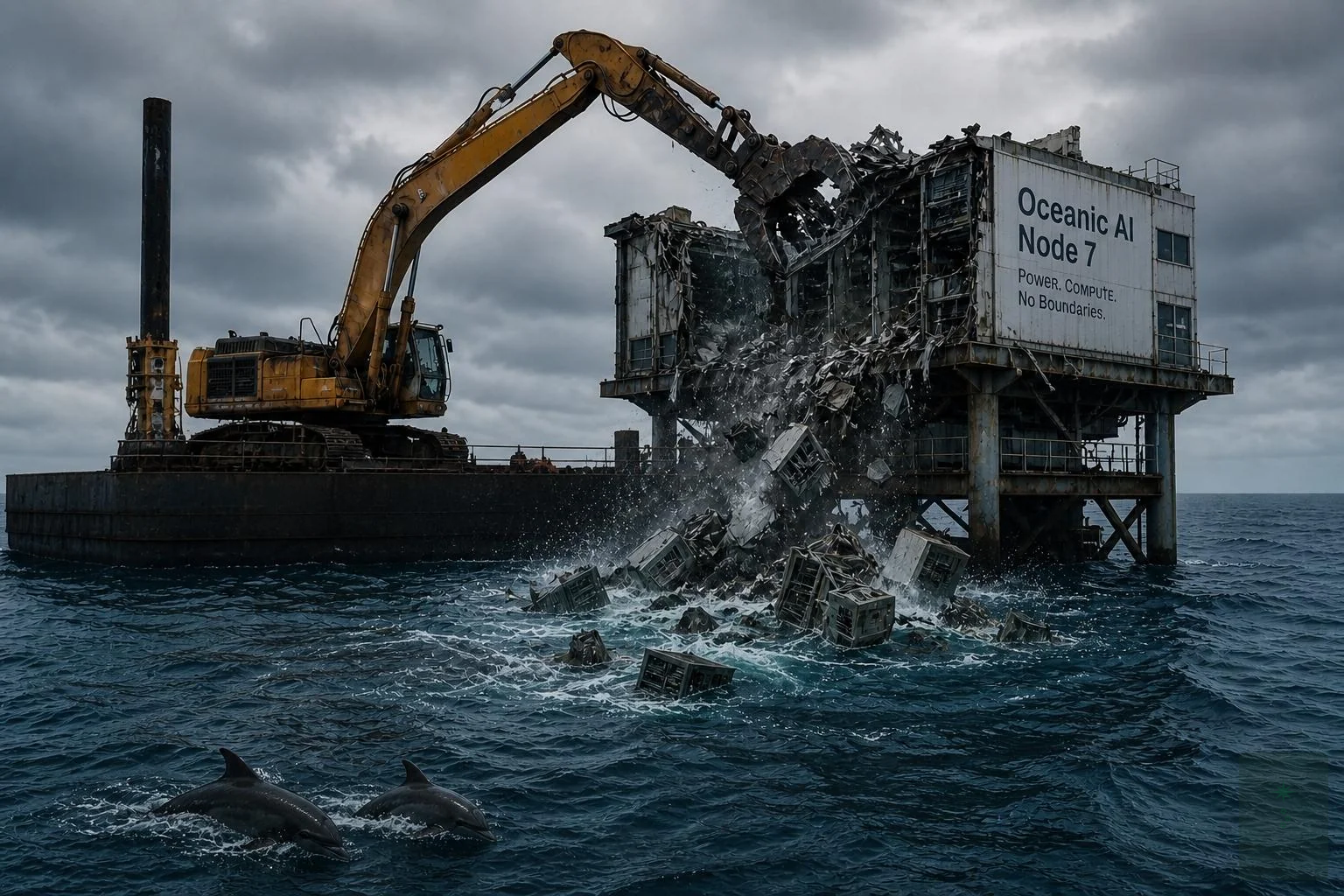
As an outdoorsman and technologist, I’ve seen nature’s bounty and technology’s promise. We need AI for our future just like we need the ocean for food and balance—if we’re careless with AI infrastructure, we risk future resources. I’m a conservationist—wise use of the outdoors, not just leaving things untouched—because responsible use of the environment, whether nature or tech, sustains our future. We’ve seen AI outpace governance on land, now capital is aiming for our oceans. Before scaling, we must settle decommissioning, environmental liability, redundancy, security, and ownership of failure by securing them with bonds. It’s not about if we can build it—it’s about who’s accountable when it corrodes or fails.
What exactly is a bond? A bond is basically a financial guarantee. In this context, it means a company sets aside money or secures a promise to pay for future cleanup or removal. If they don’t follow through, the bond ensures funds are there for someone else to handle it. In short, it’s a safety net to make sure promises about cleaning up or removing things are kept.
To reiterate, I’m not anti-tech. I’m pro rules before we scale up.
This article focuses on offshore AI data centers in U.S. waters. Other countries have different shorelines, seabed conditions, permitting systems, maritime authorities, security rules, and environmental requirements. Those differences may make offshore design, recovery, enforcement, and decommissioning easier or harder elsewhere. But in the United States, the core questions remain: who permits it, who secures it, who shuts it down in an emergency, and who pays to remove it when it fails?
Panthalassa claims to pioneer wave-powered, floating AI data centers. They raised $140 million, led by Peter Thiel, aiming to deploy autonomous 85-meter steel nodes in the open ocean. These structures purport to convert wave motion into electricity for onboard AI chips while cooled by seawater. They reportedly rely solely on satellite/low-Earth-orbit backhaul for data transmission, boasting no cables. Panthalassa positions this as the next frontier, providing AI compute at sea and circumventing terrestrial limitations. These claims require independent verification before being treated as infrastructure fact.
The appeal they claim is straightforward: fewer land-use battles, natural seawater cooling, and avoiding the complex regulatory environment of terrestrial sites. The promise is a cleaner footprint—on paper—by shifting operations offshore. The main risk is that AI hardware, already short-lived on land, will face even faster degradation at sea due to saltwater corrosion, biofouling, and harsh weather. Without proactive lifecycle planning, retrieval might be costlier than replacement.
Biofouling is the accumulation of microorganisms, plants, algae, or animals on surfaces submerged in water. Over time, this biological growth can degrade materials, reduce efficiency, and increase maintenance needs for underwater structures.
If it costs more to retrieve corroded offshore AI nodes than to abandon them, companies will be incentivized to salvage valuable parts and leave the rest behind. Without strict decommissioning rules and oversight, the ocean risks becoming a graveyard for obsolete AI infrastructure.
The Bureau of Ocean Energy Management (BOEM) should be the primary agency mandating bonded decommissioning before any offshore AI compute deployment. Coordination will be required with other agencies like the Environmental Protection Agency (EPA) for environmental impacts and the US Coast Guard for maritime safety. This bond must be large enough to cover worst-case recovery, corrosion cleanup, storm debris, and full removal. Without such pre-funded accountability, abandonment becomes an economic option.
BOEM is the Bureau of Ocean Energy Management, the U.S. agency under the Department of the Interior that manages offshore energy and mineral development on the Outer Continental Shelf. For offshore AI data centers, BOEM is the logical agency to help set early rules for siting, environmental review, financial assurance, and decommissioning expectations. In plain English: BOEM is where “cool ocean idea” should meet “who removes this when it fails?”
Jamming: satellite-only communications can be disrupted, degrading control, telemetry, customer output, and emergency coordination.
Spoofing: false signals or forged control data could mislead operators about platform location, system status, weather response, or safety conditions.
Control loss: if communications fail, the platform may become unreachable during storms, mechanical failures, intrusion, fire, collision risk, or drift events. This risk becomes systemic if satellite is the only path in or out.
Emergency authority: the U.S. needs a clear answer before deployment: who can order shutdown, recovery, boarding, tow, quarantine, or removal?
The environmental questions are just as important. Environmental review must cover more than visible debris. Surface markers and exclusion notices may be required to reduce collision, anchoring, fishing-gear, and net-entanglement risks. Submerged infrastructure raises coordination issues with military subsurface assets, survey vessels, cable routes, and emergency responders. Submerged compute introduces questions about heat discharge, corrosion debris, electromagnetic fields, electrical leakage, acoustic output, seabed disturbance, fisheries conflict, and marine mammal effects. Before deployment, operators should prove the platform does not become an electrical, acoustic, thermal, or debris hazard in U.S. waters.
PRECEDENTS
Microsoft Natick: Phase 1, Leona Philpot, ran off California from August-November 2015, about 30 feet underwater, for 105 days. Phase 2, Northern Isles, deployed off Orkney (UK) in 2018, ran 117 feet down for two years, and was recovered in 2020. Microsoft reported 1/8th the server failure rate of land controls, then committed recycling and seabed restoration. Microsoft later confirmed the project was inactive by 2024. Good precedent because recovery, inspection, recycling, and seabed restoration were built into the test.
China / Hailanyun / HiCloud: 2024-2026 commercial scaling shows undersea data centers are moving from experiment to commercial use, but transparency and environmental detail remain thin. Reported modules around 35 meters suggest shallow-water infrastructure, not deep-ocean deployment.
Massachusetts offshore wind: proves ocean infrastructure gets messy fast: delays, debris, lawsuits, contract fights, fisheries conflict, and public trust damage. Vineyard Wind blade failure hit in July 2024; GE/Vineyard contract fight escalated in April 2026, including the reported $853M dispute and is ongoing as I type this.
Offshore AI data centers may succeed, but only if regulators are involved early enough to shape the rules before capital outruns responsibility. BOEM should open a formal working process now with developers, engineers, insurers, maritime operators, fisheries, environmental reviewers, and security stakeholders. The goal should not be obstruction. The goal should be realistic investor expectations, enforceable decommissioning bonds, redundancy requirements, emergency authority, and removal plans before deployment. No bond, no launch.
Consulting: Need independent analysis or security support? See AI & Cybersecurity Consulting.