
This essay reflects the context at publication. Laws, products, organizations, and technical capabilities may have changed since then.
AI Ended At-Home Academic Integrity. The Two Track Classroom Is Next.
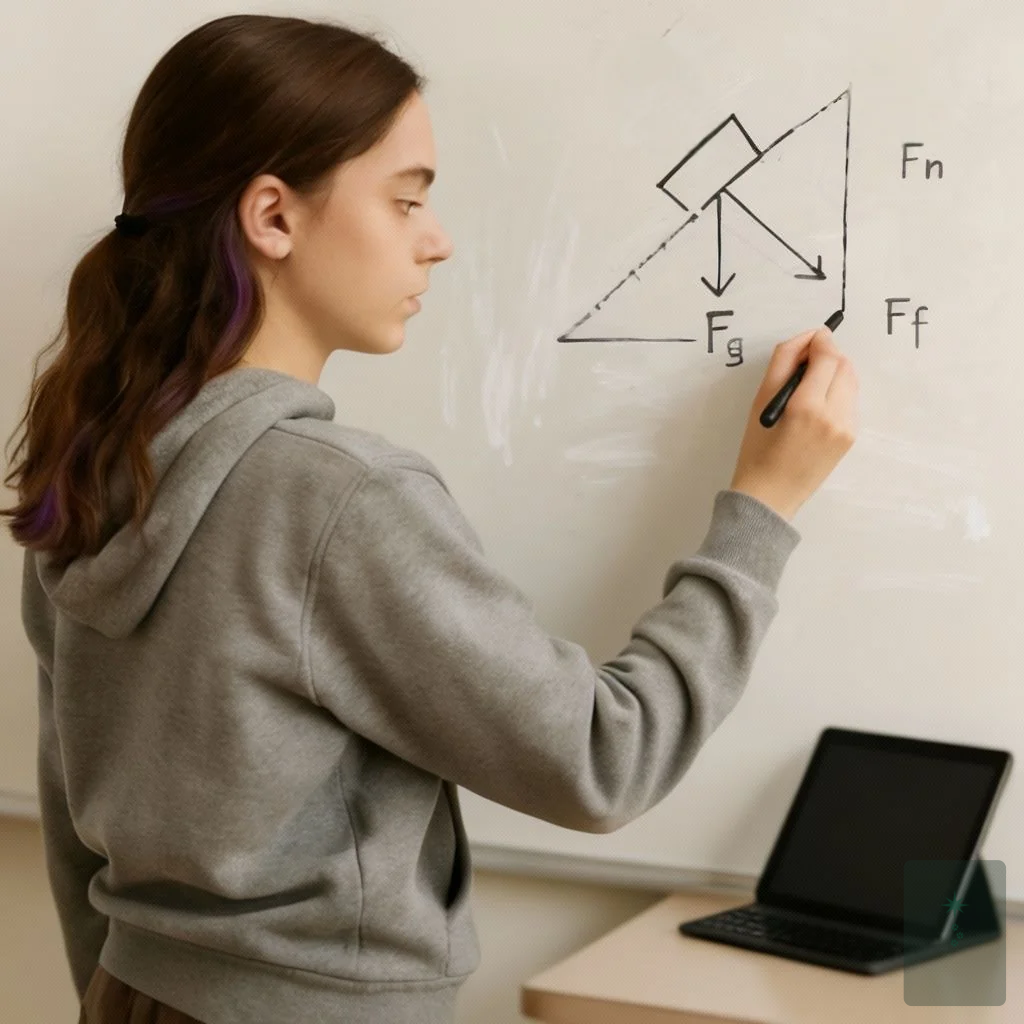
A parent’s view from inside the storm – why supervised evaluation and structured AI literacy are the only path forward for this generation.
Let’s stop pretending. AI has already ended at-home academic integrity. It didn’t crack it – it wiped it out. And this includes home schools and charter students. The issue isn’t where learning happens; it’s whether the work is supervised. As Andrej Karpathy put it: “You will never be able to detect the use of AI in homework. Full stop.”
As a former home-school parent now watching my daughter move through today’s classrooms, I’m not worried about AI replacing her work – I’m worried about schools clinging to systems that no longer protect her ability to think for herself. I’ve seen both sides of education up close. This shift isn’t optional anymore.
AI detectors are a false sense of control, not a governance system. Teachers know this already: a rewrite defeats them, a style–shift defeats them, a quick human cleanup defeats them, model updates defeat them, and false positives damage trust between parents and their children. The deeper issue is structural, you cannot build policy on a technology students can bypass with minimal effort. If work is unsupervised, the only rational assumption is that AI is involved. That isn’t pessimism; it’s accurate situational awareness. Integrity has to live where AI can’t interfere. That means supervised evaluation: timed writing, oral explanations, observable problem–solving, practical labs, and genuine real–time reasoning. Karpathy is blunt about this: “The majority of grading has to shift to in-class work… where teachers can physically monitor students.” This isn’t punishment. It’s a reset, a re-grounding. Bringing evaluation back onto solid, observable footing. A fair measure of the student, not the model. Fair to both the student and the teacher.
Homework isn’t obsolete; it needs a new mission. At home, the goal must shift from proving authenticity to developing capability. Students should learn iterative prompt craft, verification habits, hallucination and bias detection, failure mode recognition, truth fluency in a synthetic information era, foundational research discipline, comparing sources, cross checking claims, and learning age–appropriate research ethics. AI should be treated like a highly capable research partner in a group project: fast and useful, but not infallible.
What this shift isn’t about: This isn’t about blaming students, it’s about recognizing that we’ve put them in a setup where temptation is built in, and the tools are too powerful to ignore. If we’re honest with ourselves with our parent hat on, we’ve made it harder than it needs to be for them to show what they really know. It’s not a trust issue, it’s a structure issue. The world changed, and our educational design hasn’t caught up. Our kids are smart, resourceful, and curious so that’s not the problem. The problem is we’ve asked them to navigate new technologies with old rules. Moving evaluations into the classroom isn’t about control; it’s about giving students a space to show up without interference. We owe our youth that kind of clarity and they deserve a playing field where their own effort shines.
This is the real target: students fluent with AI, yet resilient without it. Karpathy’s line captures it cleanly: “Students should be proficient in the use of AI, but also able to exist without it.” That is the line between fluency and dependence, and too many schools are currently on the wrong side.
Three common strategies fail immediately: detectors paired with traditional homework, banning AI outright, or letting AI drive everything. None produce thinkers and none prepare students for a world where AI is powerful, fast, and frequently wrong. Only a redesigned two track system works: supervised, authentic performance in the room, and structured AI fluency and research competency at home. This isn’t theory for me. It’s about my daughter, her friends, every student walking into a world where AI is normal, and mistakes can be costly. Educators shouldn’t fight AI; they should design with it. Bring integrity back into the classroom. Build AI fluency outside it. Create students who can use AI and still think on their own when it counts. Schools that embrace this two track model will raise the most capable generation in decades and that’s what our children deserve.
Updated Version 1.1, 11.29.2025
Free Curriculum Download-No Email Required (full 6 lesson AI Education Pack for High School Students, Parents & Teachers)
Author’s Note: AI tools assisted in drafting, editing, and image prep for this piece. All opinions, arguments, and conclusions are entirely my own.
If this sparked something for you, share it. We're not just talking about AI or tech. We're talking about how education keeps its soul when the world changes fast.
#education #AIinEducation #DigitalLiteracy #SchoolLeadership #ParentVoice
Consulting: Need independent analysis or security support? See AI & Cybersecurity Consulting.